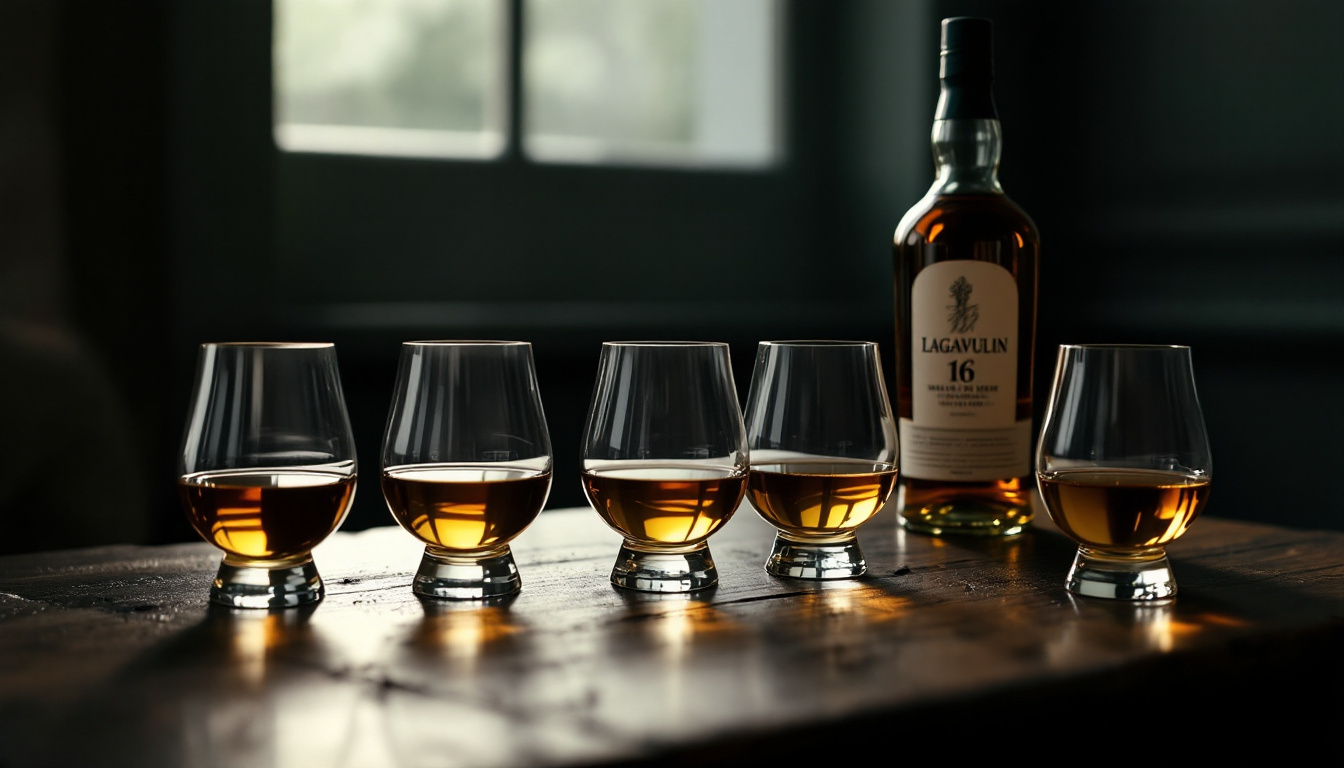
The verdict Lagavulin 16 remains the reference point for medicinal-maritime Islay peat: complete, integrated, and — at around £80 — one of the few genuinely premium drams that has not abandoned its everyday buyer. A near-faultless core expression.
There are bottles that win arguments and bottles that end them. Lagavulin 16 belongs to the second category. We acquired three bottles at the public rate — two UK 70cl, one US 750ml — and tasted them blind in a flight of four peated Islay malts, with the labels masked and the pours randomised across two sessions. By the second session the panel had, without conferring, ranked the same glass first each time. That glass was the Lagavulin.
This is the core expression of a distillery on the south shore of Islay, and it is the bottle most often handed to a newcomer as the definition of what serious peated Scotch is supposed to taste like. The interesting question for the desk was not whether it is good — that is settled — but whether, scored coldly against our rubric, it still justifies the reputation it has accumulated. It does, and the margin is wider than we expected.
Tasting context
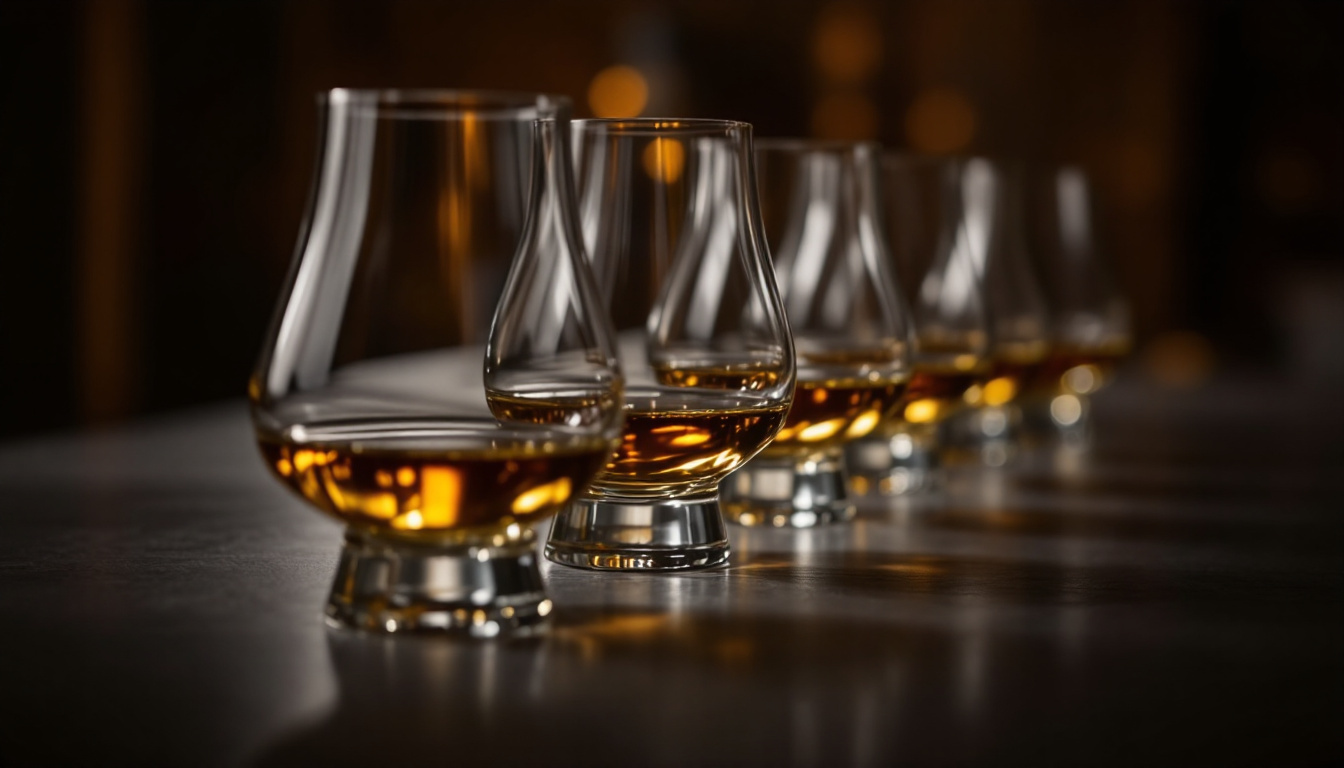
Each bottle was poured into Glencairn glasses at room temperature, assessed neat, then revisited with a few drops of water. The flight also included two younger peated Islay malts and one heavily sherried competitor, all masked. The Lagavulin was identified correctly by every panellist within seconds of the first nose — not because it announced itself loudly, but because it announced itself completely.
Nose. Lapsang souchong tea, iodine, and warm tar, wrapped around a surprisingly sweet core of dried fruit and vanilla from the sherry component. There is woodsmoke here, but it is the smoke of a cold hearth the morning after rather than a bonfire. Sea spray sits underneath everything.
Palate. Thick and oily on entry. Peat arrives as a savoury, almost meaty smoke rather than an ashy one, threaded with brine, black pepper, and a dark-sugar sweetness that keeps the whole thing from ever reading as austere. The 43% ABV is doing quiet work — there is more weight here than the proof suggests.
Finish. Long, dry, and gently medicinal, with smoke and salt fading over a measured count rather than collapsing. On our sessions the finish ran past a minute on every pour, which is the single clearest signal of the whisky’s class.
Scoring against the Premium Standard
We score every spirit on a 20-point scale across five weighted dimensions. Lagavulin 16 posts one of the most balanced score profiles we have recorded for a core-range bottling.
| Dimension | Weight | Score (of weight) |
|---|---|---|
| Substance (the liquid) | 30% | 5.6 / 6.0 |
| Execution | 25% | 4.6 / 5.0 |
| Presentation | 20% | 3.6 / 4.0 |
| Setting / provenance | 15% | 2.8 / 3.0 |
| Value | 10% | 1.4 / 2.0 |
| Total | 100% | 18.0 / 20 |
Substance is where the whisky earns its standing: completeness, oiliness, and a finish that does not quit. Execution reflects the consistency of the integration — across three bottles from two markets we found no meaningful batch divergence, which at this price point is its own achievement. Provenance is close to maximal; Lagavulin is one of a small handful of distilleries whose name alone communicates a style. The single deduction worth flagging sits in Value, and it is a deduction only against the absolute — at around £80 the bottle is, by the standards of premium single malt, a near-gift. We withhold the final fraction only because the 43% bottling leaves a tantalising sense of what a higher-strength version might deliver.
Where it sits
Against the broader premium peat field, Lagavulin 16 occupies an unusual position: it is simultaneously the safe choice and one of the best choices. There are more intense Islay malts and more cerebral ones, but very few that are this resolved. Nothing is unfinished; nothing is reaching. For a buyer who will actually open and drink the bottle — our preferred buyer — there are perhaps a dozen single malts under three figures that we would rank alongside it and none we would unambiguously rank above it.
The only honest caution is stylistic rather than qualitative: this is medicinal, maritime, smoke-forward Scotch, and a drinker who dislikes peat will not be converted. But within its idiom it is as close to definitive as a core bottling gets, and our scoring reflects that.
The Premium Standard: 18.0 / 20
Verification
Every factual claim in this review was checked against external sources before publication, on 2026-04-11. Where a figure could not be independently confirmed, it is described in approximate terms in the text. To challenge a fact, write to corrections@premiumtravelreview.com.
Frequently asked questions
- What is the ABV and age statement of Lagavulin 16?
- It carries a firm 16-year age statement and is bottled at 43% ABV, matured predominantly in ex-bourbon and ex-sherry oak.
- How much does Lagavulin 16 cost?
- UK retail typically runs around £75–£90 for a 70cl bottle; US pricing is commonly in the $90–$120 range, though it varies by market and availability.
- Is Lagavulin 16 worth the money?
- For a 16-year-old single malt of this completeness, it is among the most defensible premium purchases in Scotch. The price-to-quality ratio is exceptional.
- How does it differ from the Distillers Edition?
- The standard 16 is the core bottling; the Distillers Edition takes the same whisky and finishes it further in Pedro Ximénez sherry casks, adding a sweeter, raisined top layer.