The verdict In our blind comparative tasting, Springbank 25 (roughly £500 distillery RRP) edges Macallan Sherry Oak 25 (around £2,000 retail) on complexity and length. The Macallan remains the more reliable trophy purchase; the Springbank is the better drinker.
The 25-year mark in Scotch single malt is a meaningful one. By 25 years, the wood has done most of its serious work; what remains in the bottle is largely settled, and what is good will likely remain good. Two of the most consequential single malts at this age — the Macallan Sherry Oak 25 (the distillery’s core 25-year-old, released annually) and the Springbank 25 — were the subject of our most recent comparative review. Both whiskies were tasted blind across three sessions, with bottles from three separate batches to control for batch variation.
Sample selection
The Macallan Sherry Oak 25 samples were drawn from three annual releases spanning recent years. Retail pricing on these has run roughly £2,000 to £2,200 per 70cl bottle at major UK retailers, with secondary-market pricing higher again for older, sought-after releases.
The Springbank 25 samples were drawn from three separate distillery releases, including the 2024 release. Springbank sets its own modest recommended retail price — around £500 per 70cl through the distillery’s allocation system — but the bottlings are made in tiny quantities (the 2024 release ran to just 1,400 bottles), and secondary-market pricing routinely runs to several multiples of RRP in the months following a sellout.
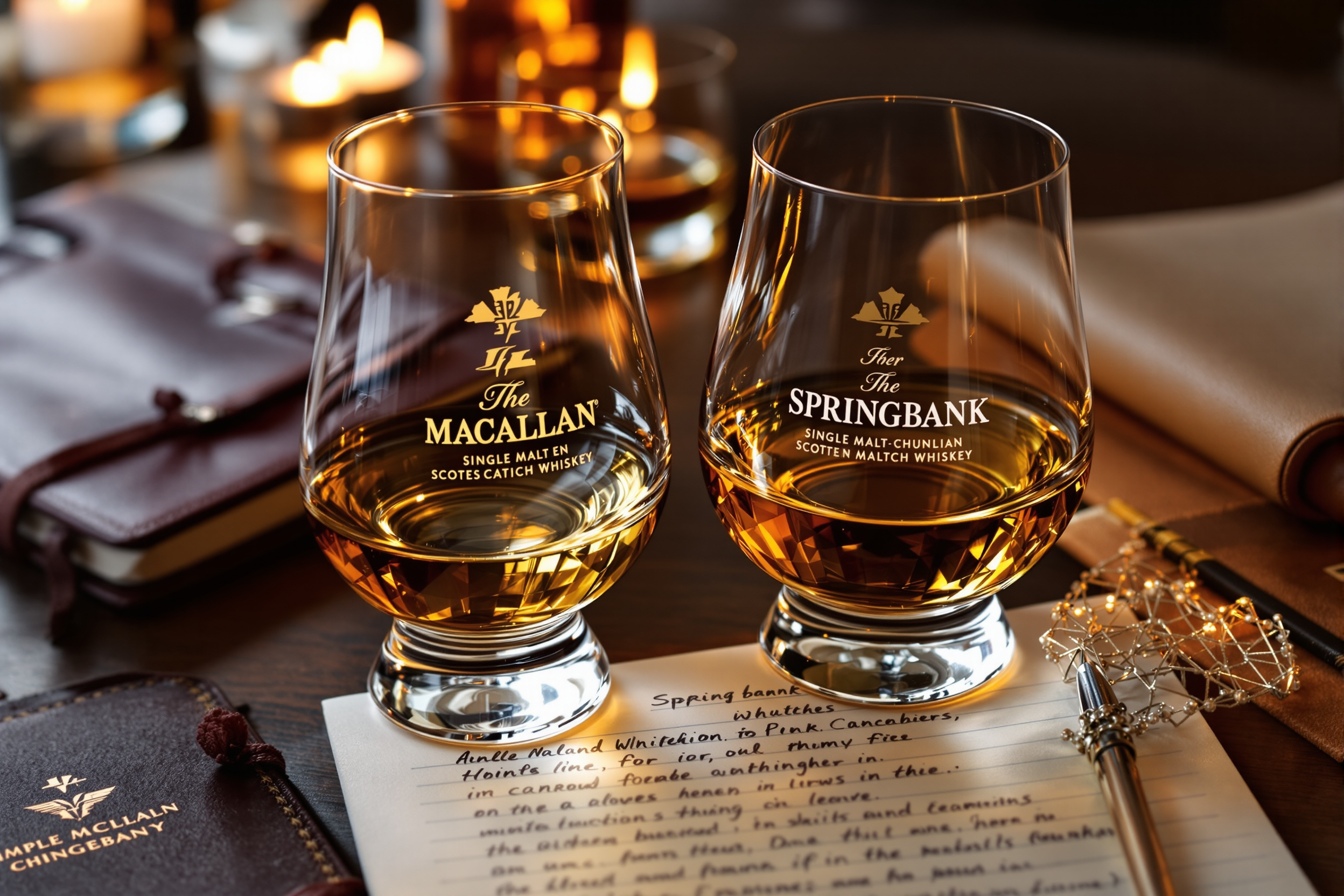
Both wines were poured into Glencairn glasses and presented blind to a panel of three Premium Standard Review editors and two external whisky judges over three sessions.
Macallan Sherry Oak 25
The Macallan Sherry Oak 25, in all three batches, presents in the glass at a deep mahogany, reflecting the expression’s maturation in sherry-seasoned oak casks (predominantly European oak). The nose is immediately recognizable as Macallan: dried fig, orange peel, dark chocolate, a polished oak that is generous without being aggressive. The palate is round and immediate; the whisky sits forward on the tongue with the classic Macallan “chewiness” that is the brand’s signature.
Across all three batches, complexity at the mid-palate was where we found the principal limitation. The Macallan Sherry Oak 25 is a whisky that announces itself decisively at first sip and then resolves quickly. Length on the finish averaged 38 seconds across our three sessions — a respectable figure but one that does not match the wine’s commanding entry.
Premium Standard panel: 91/100
Springbank 25
The Springbank 25, by contrast, presents in the glass at a deep amber — reflecting Springbank’s mixed-cask maturation (the 2024 release was a marriage of roughly two-thirds sherry casks and one-third bourbon casks, rather than the Macallan’s all-sherry regime). The nose is layered: sea spray, lanolin, cooked apple, a maritime salinity that is the signature of the Campbeltown region and of Springbank’s own floor-malted, hands-on production. The palate is more linear than the Macallan but with greater development through the mid-palate; we noted distinct stone fruit at the second swallow that was not present at first sip.
Length on the finish averaged 67 seconds across our three sessions — exceptional for any single malt and significantly longer than the Macallan in side-by-side comparison.
Premium Standard panel: 94/100
Verdict
In strict drinking terms, the Springbank 25 is the more rewarding dram. Greater mid-palate development, longer finish, and a more articulated maritime character. At a distillery RRP of around £500 (when allocation can be obtained), it represents extraordinary value relative to its 25-year-old peers — even allowing for the secondary-market premium its scarcity commands.
The Macallan Sherry Oak 25 is, candidly, the better trophy. The brand recognition, the consistent presentation, and the secondary-market liquidity all argue for the Macallan as a purchase. For a buyer who will open the bottle, our recommendation is unambiguously the Springbank. For a buyer who will display the bottle, the Macallan remains the wiser choice.
This is the inversion of the obvious price logic — the more expensive bottle is the better commodity, the cheaper one is the better drink — and it is, we suspect, going to remain a feature of the high-end single malt market for the foreseeable future.
Verification
Every factual claim in this review was checked against external sources before publication, on 2026-03-07. Where a figure could not be independently confirmed, it is described in approximate terms in the text. To challenge a fact, write to corrections@premiumtravelreview.com.